
 (813) 397 8637
Writing a book is a huge achievement, but finishing your manuscript is only the beginning. The next question almost every author asks is, “When will my book finally be available for readers?”
The answer depends on many factors, including the publishing method you choose, how polished your manuscript is, and how much work is left before launch.
Some books reach the market in just a few weeks, while others take more than a year. That difference surprises many first-time authors.
Publishing involves much more than simply uploading a file or printing a few copies. Editing, design, formatting, marketing, and distribution all take time if you want your book to make a strong impression.
If you’ve been wondering how long does it take to publish a book, this guide will walk you through every stage of the process.
You’ll learn what affects the timeline, what to expect from different publishing options, and how to avoid common delays so your book reaches readers as smoothly as possible.
How Long Does It Take to Publish a Book?
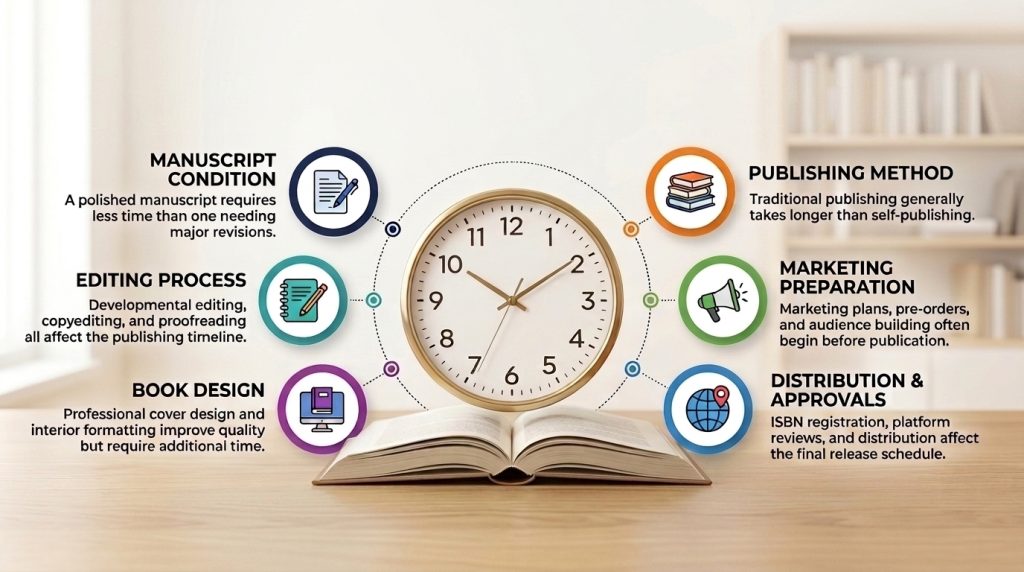
There isn’t one simple answer because every author’s journey is different. However, most publishing timelines fall into three general categories.
Traditional publishing usually takes between twelve and twenty-four months after a publisher accepts your manuscript. This longer schedule includes editing, cover design, printing, marketing, and planning a release date that fits the publisher’s calendar.
Self-publishing is much faster. Many authors publish their books in one to six months, depending on how quickly they complete editing, formatting, and cover design.
Hybrid publishing falls somewhere in the middle. Since authors often have more control over the schedule while still receiving professional support, many hybrid publishers release books within three to nine months.
The biggest lesson is simple. A faster timeline is possible, but quality should never be sacrificed just to publish sooner.
What Determines How Long It Takes to Publish a Book?
Every book follows its own path, and several factors influence how quickly it moves from manuscript to bookstore.
The biggest factor is the condition of your manuscript, if it is polished draft that requires only minor edits can move much faster than one that needs major rewriting.
Your publishing method also plays a huge role. Traditional publishers follow longer production schedules, while self-publishing platforms allow authors to control nearly every deadline.
Professional editing takes time as well. Developmental edits, copyediting, and proofreading each one of these improve your book in different ways. Skipping these steps may save time, but it often hurts the final product.
Book design is another important stage. A professionally designed cover and proper formatting help your book look credible and appealing.
Finally, marketing preparation can affect your launch date. Many successful books begin building excitement weeks or even months before publication.
Traditional Publishing Timeline
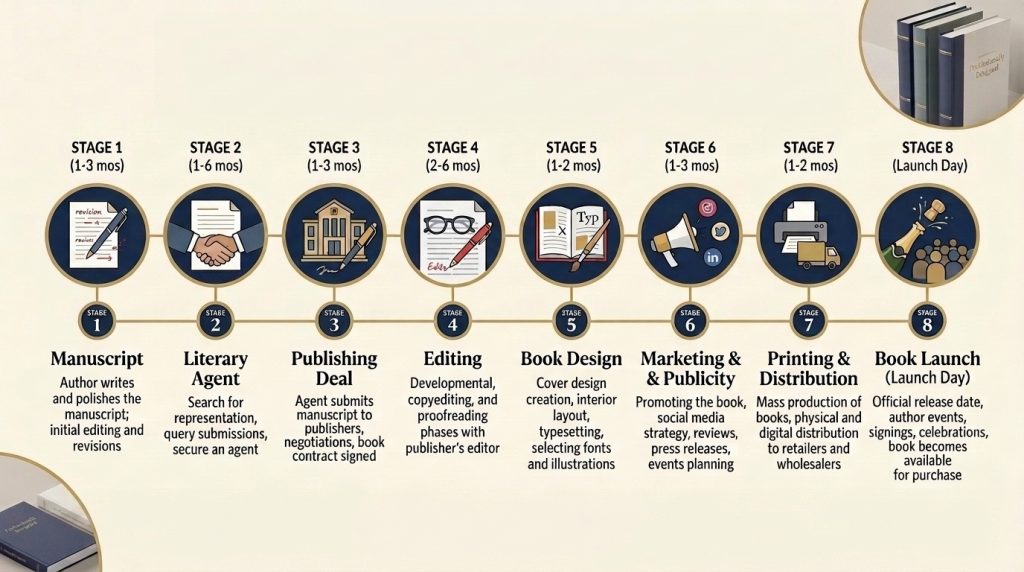
Traditional publishing offers professional support and wide distribution, but it also requires patience. Every publishing stage is planned carefully, which means the process often takes much longer than new authors expect.
Step 1: Finish and Polish Your Manuscript
Before contacting agents or publishers, your manuscript should be as strong as possible. Publishers expect polished work, not rough drafts.
After finishing your first draft, spend time revising it yourself. Read each chapter carefully, fix weak sections, remove unnecessary scenes, and improve dialogue. Many authors also ask beta readers for honest feedback before moving forward.
Rushing this stage usually creates bigger problems later. A well-polished manuscript has a much better chance of attracting interest.
Step 2: Find a Literary Agent
Most traditional publishers do not accept direct submissions from new authors. Instead, you’ll need a literary agent who represents your work.
Finding the right agent involves researching agencies, writing a strong query letter, and submitting sample chapters. Then comes the hardest part waiting.
Some agents respond within a few weeks, while others may take several months. Rejections are common, even for excellent books, so persistence is part of the process.
Landing the right agent is worth the effort because they negotiate contracts and help place your book with publishers.
Step 3: Secure a Publishing Deal
Once an agent agrees to represent your book, they begin pitching it to publishing houses.
Editors review submissions carefully before deciding whether to make an offer. Even after receiving interest, contract discussions can take additional time.
Some books receive offers quickly, while others spend months going through submissions before finding the right publisher. Patience is essential because publishers invest heavily in every title they choose.
Step 4: Professional Editing and Revisions
After signing a publishing contract, the real work begins.
Professional editors help strengthen your manuscript through multiple editing stages. You may be asked to rewrite chapters, improve pacing, or clarify certain ideas.
The editing process often includes:
- Developmental editing for structure and story
- Copyediting for grammar, style, and consistency
- Proofreading to catch final errors before printing
Although revisions can feel demanding, they often transform a good manuscript into a great book.
Step 5: Book Design and Production
Once editing is complete, your book moves into production.
Designers create an attractive cover that fits your genre and appeals to readers. At the same time, the interior is formatted so every page looks clean and professional in both print and digital versions.
The publisher also assigns an ISBN, prepares metadata, and performs final quality checks before approving the finished files for printing.
This stage requires careful attention because small mistakes can affect the reader’s experience.
Step 6: Printing, Marketing, and Book Launch
Many people assume a book is published as soon as editing ends, but there is still plenty left to do.
Publishers often print advance review copies months before release. These copies go to reviewers, bookstores, influencers, and media outlets to build excitement.
Marketing campaigns, pre-orders, interviews, and promotional events are planned well before launch day. Finally, once everything is ready, the book becomes available through bookstores and online retailers.
This careful planning explains why traditional publishing takes much longer than many first-time authors expect.
Self-Publishing Timeline

Self-publishing gives authors complete control over their schedule. If you’re organized and prepared, your book can reach readers much faster.
Writing and Editing Your Manuscript
Even though self-publishing moves faster, quality should never be rushed.
Complete your manuscript, revise it carefully, and hire professional editors whenever possible. Many successful self-published books go through the same editing process as traditionally published titles.
Skipping editing may save time today, but poor reviews can damage your book’s success for years.
Designing Your Book
Readers often judge a book before reading the first page.
A professional cover immediately creates trust and attracts attention. Interior formatting should also be clean and easy to read on both printed pages and eBooks.
You’ll also need an ISBN if you want complete publishing control, although some platforms offer free options.
Investing in professional design helps your book compete with titles from major publishers.
Uploading to Publishing Platforms
Once your files are ready, it’s time to upload them to publishing platforms.
Popular options include Amazon Kindle Direct Publishing, IngramSpark, and several other online distributors.
During this stage, you’ll add your book description, keywords, pricing, categories, and publishing information before submitting your files for review.
Double-check every detail because small mistakes can affect your book’s visibility.
Review Process and Going Live
Most self-publishing platforms review submissions before making them available for purchase.
Digital books are often approved within a few days, while printed editions may take slightly longer because production files need additional checks.
After approval, your book becomes available to readers around the world.
This speed is one reason many independent authors choose self-publishing when they want faster results.
Traditional Publishing vs. Self-Publishing Timeline
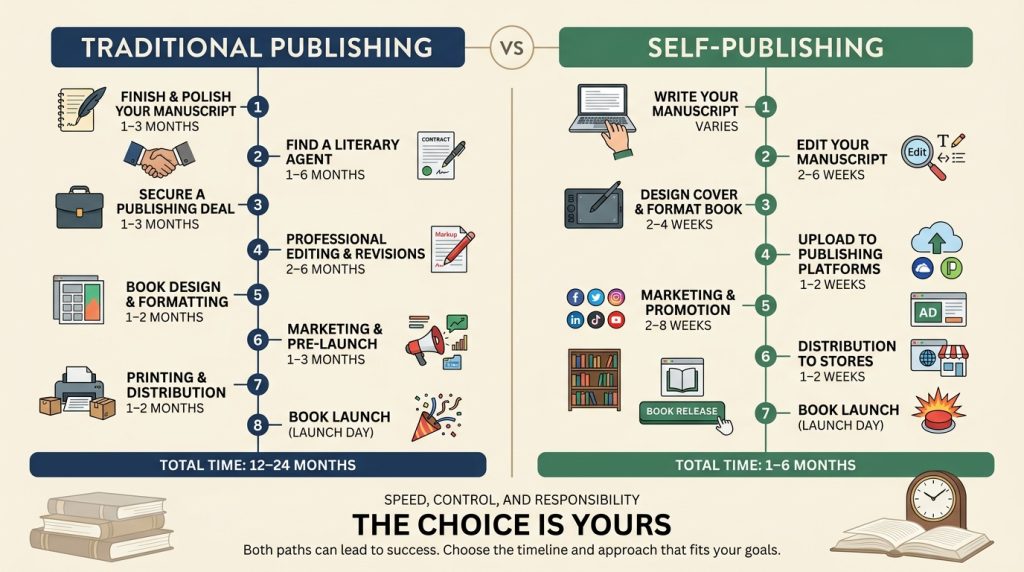
Choosing between publishing methods depends on your goals rather than speed alone.
| Traditional Publishing | Self-Publishing |
|---|---|
| Usually takes 12–24 months | Often takes 1–6 months |
| Publisher covers production costs | Author pays for services |
| Limited creative control | Full creative control |
| Lower royalty percentage | Higher royalty percentage |
| Publisher assists with distribution | Author manages distribution |
| Professional publishing team | Author hires professionals as needed |
Traditional publishing offers industry support and prestige, while self-publishing provides flexibility and faster release dates. Neither option is automatically better. The right choice depends on what matters most to you.
How to Publish Your Book Faster Without Sacrificing Quality
Every author wants to save time, but rushing important steps often leads to disappointing results. Instead of cutting corners, focus on working smarter.
Start by finishing your manuscript before contacting publishers or designers. Trying to complete multiple stages at once usually creates delays.
Hire experienced editors and cover designers early so you aren’t waiting for availability later. Good professionals often book projects weeks in advance.
Prepare your marketing before publication instead of waiting until launch day. Build an author website, grow your email list, and connect with readers while your book is still in production.
Most importantly, set realistic deadlines. A well-planned schedule keeps your project moving without creating unnecessary stress.
Common Delays That Can Slow Down Book Publishing
Even the best publishing plans can run into unexpected problems.
One common delay is submitting an unfinished or poorly edited manuscript. Major revisions add weeks or even months to the timeline.
Finding the right literary agent also takes patience. Many authors submit dozens of queries before receiving representation.
Design revisions can cause additional setbacks if cover concepts need multiple changes before approval.
Printing delays sometimes happen because of supplier issues or increased demand, especially during busy seasons.
Marketing plans may also shift if publishers decide to move release dates for better sales opportunities.
Understanding these challenges helps you prepare realistic expectations instead of becoming frustrated when progress slows.
Self Book Publishing Timeline
A typical schedule for self publishing a book generally looks like this:
- Months 1–3: Completing book manuscript.
- Month 4: Revise and self-edit.
- Months 5–6: Professional editing and revisions.
- Month 7: Cover design, formatting, and final proofreading.
- Month 8: Upload files, complete platform review, and prepare marketing.
- Month 9: Official book launch.
A traditional publishing schedule follows many of these same stages but adds literary agent submissions, publisher review, contract negotiations, and longer production planning, which is why the entire process often stretches well beyond a year.
Is It Better to Publish Quickly or Take Your Time?
Publishing quickly sounds exciting, but readers only notice quality far more than speed.
A polished book earns stronger reviews, builds your reputation, and encourages readers to buy your future work. On the other hand, rushing through editing or design often results in mistakes that are difficult to fix after publication.
Think of your book as a long-term investment rather than a race. Spending a few extra months improving it can make a huge difference in how readers respond.
If you’re asking how long does it takes to publish a book, the better question might be, “How long should I spend creating the best version of my book?” That mindset leads to better results every time.
Conclusion
Publishing a book is an exciting journey, but it rarely happens overnight. From fixing wrong verb tenses and broken sentence structures to design, printing and marketing, every stage plays an important role in creating a book readers will enjoy and recommend.
Traditional publishing usually requires patience because many professionals are involved throughout the process. Self-publishing offers a much faster route, but it also gives authors greater responsibility for producing a high-quality book.
No matter which path you choose, remember that your goal isn’t simply to publish quickly. Your goal is to publish a book that makes readers happy they spent their time and money on it.
Plan carefully, stay organized, and focus on quality at every step. The time you invest today will help your book stand out long after it reaches the hands of your readers.
Frequently Asked Questions
The time it takes to publish a book depends on the publishing method you choose. Traditional publishing often takes 1 to 3 years because of the time needed to find a literary agent, secure a publishing deal, edit the manuscript, design the book, and plan marketing. Self-publishing is much faster and can take anywhere from a few weeks to several months, depending on how quickly you complete editing, formatting, and cover design.
Most authors can self-publish a book within 1 to 6 months. The timeline depends on the quality of your manuscript and how much work is needed before publication. If your book is already edited, professionally formatted, and has a finished cover, you could publish it in just a few weeks.
The publishing process usually includes writing the manuscript, editing and proofreading, designing the cover, formatting the interior, obtaining an ISBN if needed, choosing a publishing platform or publisher, uploading the files, reviewing the final proof, and publishing the book. After publication, many authors focus on marketing and promoting their work to reach readers.
Editing and proofreading can take anywhere from 2 weeks to several months. A shorter manuscript with minimal revisions may be completed quickly, while a longer or more complex book often requires multiple rounds of editing. Investing enough time in this stage helps improve the quality of the final book.
Publishing on Amazon KDP is usually very fast. Once you upload your manuscript and cover, Amazon typically reviews your book within 24 to 72 hours. If everything meets the platform’s guidelines, your book will become available for purchase shortly after approval.
Yes. Many self-published authors successfully publish their books within 2 to 6 months. This is possible when the manuscript is complete, editing is finished on schedule, and the cover design and formatting are prepared without major delays.
Several factors can influence how long publishing takes, including the length of the manuscript, the amount of editing required, cover design, formatting, the publishing method you choose, approval times on publishing platforms, and how quickly you make revisions or respond to feedback.
Yes. Self-publishing is generally much faster because authors control the entire process and do not need to wait for literary agents or publishing houses. Traditional publishing offers professional support and wider distribution opportunities, but it usually requires significantly more time before the book reaches readers.
The availability depends on the platform. Digital books published through platforms like Amazon KDP often become available within a few days after approval. Print books may take several additional days or weeks, depending on printing schedules and distribution.
You can speed up the process by finishing your manuscript before contacting editors, hiring experienced professionals for editing and cover design, preparing your files correctly, responding quickly to revision requests, and choosing a self-publishing platform if you want to publish sooner. Planning each stage in advance also helps avoid unnecessary delays.
Ready to Publish Your Book?
Still wondering how long does it take to publish a book? The answer depends on your publishing path, preparation, and the quality of your manuscript. Whether you’re choosing traditional publishing or self-publishing, having the right guidance can save you time and help you avoid costly mistakes.
At Fifth Avenue Publishers, our experienced team supports you through every stage from editing and cover design to formatting, publishing, and marketing so you can confidently bring your book to readers.