
 (813) 397 8637
You started a thrilling journey through a fictional novel, eagerly anticipating exhilarating roller coasters, a dash of Hip Hop, art, craft, love, and all the other exciting stuff. And so, you began reading.
‘Hello,’ she whispered. ‘How are you?’
‘I’m fine. How are you?’
‘Good, thanks, very good. Isn’t the weather just spectacular today?’
He beamed. ‘Oh yes, absolutely wonderful. Anyway, Jessica, there’s something I simply must ask you…’
And at what glorious moment did you sleptoff? We wrapped up at “fine”.
Bad dialogue ruins great novels faster than a terrible ending. Readers forgive a slow second act, but they drop books instantly when characters sound like customer service agents reading canned scripts.
Fifth Avenue Publishers sees thousands of manuscripts annually that fail simply because dialogue reads like mundane grocery lists. You must fix this flaw if you expect commercial success in modern publishing markets.
Mastering how to write a dialogue in a book requires technical precision and ruthless structural discipline. Search engines, readers, and literary agents all demand narrative velocity.
Stop writing filler and start engineering sharp verbal exchanges that grab attention instantly.
Dialogue That Feels Real Is Still Deliberately Crafted
Real speech contains endless pauses, awkward interruptions, and meaningless greetings that destroy narrative pacing. If you copy actual human conversations verbatim onto the page, your readers will fall asleep.
Fifth Avenue Publishers instructs authors to abandon total realism in favor of calculated artifice. Great dialogue creates the illusion of spontaneous human speech while functioning as a precise narrative engine.
You strip away the social niceties like hello and goodbye because they stall dramatic progress.
Every spoken phrase must serve a structural purpose in your chapter. You craft artificial lines to sound genuine within your fictional world while forcing the plot into higher gear.
Write Dialogue That Pulls Readers Forward Scene by Scene
Dialogue must propel the manuscript forward with unrelenting speed. Static conversations stop scene momentum completely and turn promising chapters into tedious reading exercises.
You maintain narrative tension when characters use speech to push against each other.
Every line ought to change the power balance or raise the stakes within the room. When two characters speak, the scene must end in a different state from where it started.
Readers keep turning pages because spoken words create immediate consequences that demand resolution. You build forward movement by treating dialogue as direct action rather than passive commentary on past events.
Every Line Needs a Goal Tied to The Character in Control
Characters never talk just to fill space on the page. Every participant enters a room with a specific target and fights to achieve that target through speech. The character holding power in the conversation attempts to dominate, while the opposing character maneuvers to regain control.
You must assign a clear objective to every line of dialogue before you write it. If a character has no active desire, remove them from the scene immediately.
When two opposing agendas collide in a line of speech, natural dramatic friction occurs. This friction keeps readers locked into the psychological battle between your characters.
Avoid Back and Forth Ping Pong Momentum That Goes Nowhere
Rhythmic exchanges where characters politely take turns answering direct questions create lethal boredom. This back and forth ping pong pattern lulls readers into a passive trance because the exchange lacks surprise.
Break this predictable rhythm by introducing abrupt interjections, unanswered queries, and sudden shifts in subject. People in tense situations rarely answer questions directly.
They evade, attack, or bring their own separate issues to the table. When character A asks a question, character B should challenge the premise or ignore it entirely.
Disrupting the predictable flow creates realistic verbal combat that keeps your narrative edge sharp.
Don’t Dump Information in Dialogue
Nothing exposes amateur writing faster than heavy exposition masked as speech. When characters tell each other facts they both already know just to inform the reader, the illusion shatters completely.
Phrases like as you know brother destroy author credibility instantly.
Fifth Avenue Publishers routinely rejects manuscripts that use dialogue as a cheap vehicle for worldbuilding details. You must deliver background context through active scene tension or subtext instead.
If your characters need to share technical details, force them to argue over those details. Turn facts into weapons during a conflict rather than passive educational lectures.
Subtext Makes Dialogue More Powerful Than the Explanation
Unspoken truth carries far more weight than explicit statements. When characters state their exact feelings out loud, you rob the reader of emotional participation. Skilled authors rely on subtext to build complex narrative layers.
A character experiencing overwhelming grief might simply say thank you while staring at the floor. The reader senses the immense emotional iceberg under that brief statement.
You create intense dramatic force when spoken words contradict inner thoughts. Force your audience to read between the lines and infer true motivations. Dialogue becomes unforgettable when the real story happens in the silence between spoken phrases.
Let Meaning Live Under the Words Not Beside Them
Weak manuscripts place emotional commentary right next to spoken lines through obvious action beats and redundant descriptions.
You destroy narrative tension when you explain what a spoken line means immediately after a character speaks. Let the meaning reside beneath the surface of the text.
Trust your reader to process emotional weight without hand holding or intrusive narrative guides. When a character says I am fine during a disaster, do not explain their hidden panic in the next sentence.
The contrast between short, clipped words and terrifying external circumstances creates narrative power without added authorial explanation.
Contractions Keep Dialogue Natural and Conversational
Stiff dialogue often stems from a complete lack of standard contractions. English speakers constantly compress words in daily speech to maintain vocal speed. When your characters say I cannot go instead of I can’t go, they sound like robotic entities from an ancient text.
You must use contractions like don’t, won’t, and I’m to establish fluid reading momentum. Reserve full, uncontracted phrasing strictly for rigid authority figures or historical periods that demanded extreme formality.
Applying contractions across standard dialogue removes artificial stiffness instantly and connects readers to character voices on a visceral level.
Different Voices Make Characters Believable at A Glance
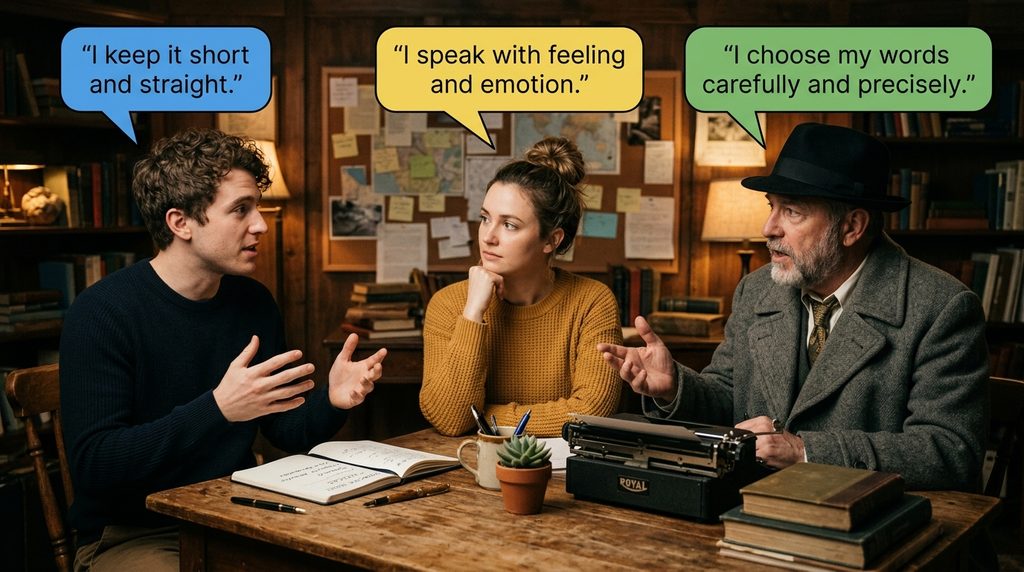
Every character must possess a unique vocal footprint that readers recognize without checking dialogue tags. If you strip away speaker tags and every character sounds identical, your cast lacks distinct identity.
You build distinct voices by varying vocabulary choices, sentence lengths, and speech rhythms based on background, age, and profession. An uneducated street vendor constructs sentences differently than a corporate lawyer. Swap out specific nouns and alter structural syntax to reflect distinct origins.
When you individualize speech patterns successfully, your audience identifies who is talking instantly, keeping the narrative flowing smoothly across every scene.
Keep Accents and Patois Minimal and Purposeful
Phonetic spelling of regional accents ruins manuscripts quickly. Writing heavy dialect with constant apostrophes confuses readers and slows down reading comprehension.
Fifth Avenue Publishers advises authors to avoid phonetic spelling hacks entirely. You do not need to drop every consonant to prove a character comes from a specific region. Instead, select one or two signature regional phrases, specific word orders, or unique vocabulary items to signal background.
Let clean prose carry the rest of the conversation. Minimalist dialect choices preserve swift narrative pacing while giving readers enough regional flavor to construct authentic accents mentally.
Use Names Carefully So the Conversation Stays Clean
People rarely address each other by name during ongoing conversations. Constantly repeating names in dialogue lines creates an artificial tone that mimics sleazy sales calls.
If two characters speak in a room, you do not need them to address each other by name every three lines.
Cut name repetitions ruthlessly during your editing process. Save name drops for critical moments like introductions, sudden shifts in attention, or intense personal confrontations.
Removing redundant names cleans up speech blocks, restores natural cadence, and stops your characters from sounding like amateur actors rehearsing lines in a play.
Clip Speech to Remove Padding and Speed Up Emotion
Trim unnecessary padding from every sentence to heighten emotional velocity. Real people use redundant filler words, but fictional dialogue demands maximum economy. Cut polite greetings, formal pleasantries, and unnecessary transition words.
Eliminating useless words like that and well sharpens tone and increases pacing dramatically. Short, clipped phrases reflect high anxiety, anger, or urgent action effectively. When stakes rise in a scene, compress sentence lengths to force readers through the text at top speed.
Ruthless trimming transforms sloppy speech into precise verbal weapons that drive emotional intensity directly into the reader’s mind.
Use Clear Dialogue Tags That Guide Without Clutter

Dialogue tags exist to identify speakers without drawing attention to themselves. The word said functions as an invisible tag that readers skip automatically while digesting spoken content.
Fancy attribution verbs like shouted, interjected, or whispered distract readers and signal amateur execution. Use said as your default tag or replace tags entirely with physical action beats.
A character standing up or turning away shows who speaks while advancing physical scene blocking. Clean attribution keeps attention focused squarely on spoken words, ensuring smooth narrative flow across every complex conversation in your novel.
Go Light on Adverbs and Let the Dialogue Carry Tone
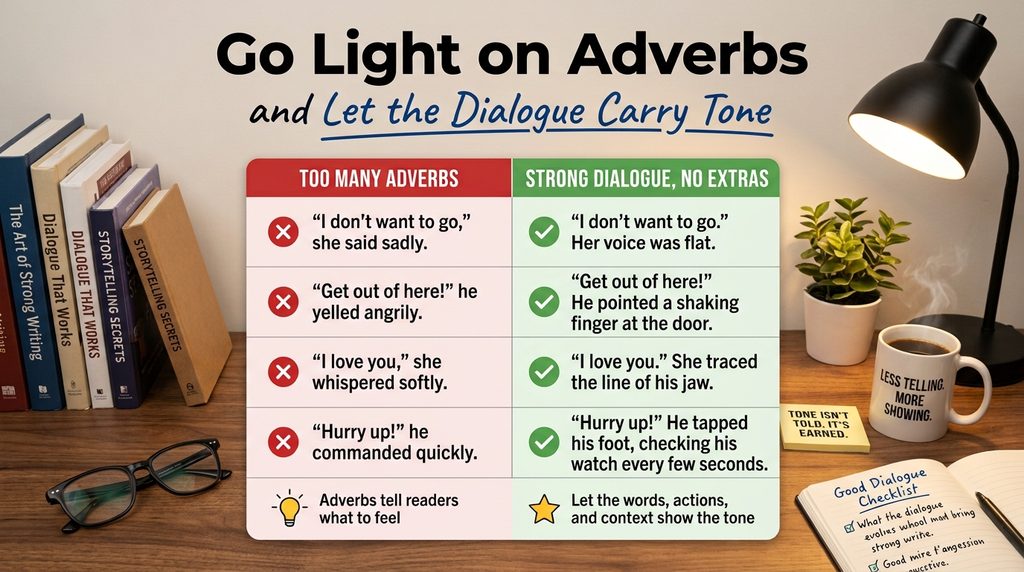
Stacking adverbs onto dialogue tags reveals weak line construction. Writing he said angrily or she said loudly tells readers you lack confidence in your spoken words. Strong dialogue carries its own emotional tone without adverbial crutches.
If the spoken words express fury, adding an adverb after the tag creates redundant clutter. Reserve adverbs exclusively for rare moments when delivery directly subverts expectations, such as a character whispering a threat quietly during a violent argument.
Otherwise, strip adverbs away completely and let precise word choices convey emotion directly to your reading audience.
Get To the Conversation Fast and Keep the Page Moving
Prolonged internal monologues at the start of scenes trap readers in static exposition. Fifth Avenue Publishers recommends launching into active dialogue as early as possible on the page.
External voices break up dense blocks of prose, create immediate drama, and pull readers straight into scene action. Do not make readers wait through pages of background setup before characters interact out loud. Open scenes near the turning point and introduce spoken exchanges quickly.
Fast dialogue keeps narrative momentum surging forward, ensuring your manuscript remains impossible to put down from start to finish.
Master dialogue and launch your book today
Send your polished manuscript to Fifth Avenue Publishers right now.
Submit Manuscript NowClosing Remarks
Mastering how to write a dialogue in a book takes ruthless practice. Fifth Avenue Publishers wants your next manuscript to succeed. Stop writing boring small talk. Start crafting sharp conversations that push the plot forward immediately.
Apply these exact rules today. Your readers will stay completely hooked, and your characters will finally sound genuinely real.
Frequently Asked Questions
Learning how to write a dialogue in a book requires assigning characters clear goals. You must cut boring small talk and force people to argue. Every spoken line must actively push your story forward now.
Keep your speech tags simple by choosing the word said almost exclusively. You must avoid dumping heavy background information into normal conversations. Characters should speak with clear intentions while keeping their sentences short and punchy.
Use standard contractions like can’t and won’t to maintain a conversational rhythm. You should listen to real people talk and mimic their natural pacing. Cut overly formal words that regular people never say out loud.
Place all spoken words inside double quotation marks. You must keep punctuation like commas and periods inside those quotation marks. Always start a brand new paragraph the second a different character begins speaking their line.
Hit the return key and begin a new paragraph every single time the speaker changes. This visual break prevents reader confusion. It helps your audience track exactly who holds the floor during a fast argument.
Wrap every spoken sentence in double quotation marks to signal speech. When a character quotes someone else while talking, you must use single quotation marks for that inside phrase to keep the text totally clear.
Give each person a distinct vocabulary and unique sentence length. An impatient character uses short words and interrupts others constantly. A nervous character rambles and asks multiple questions without waiting for anyone else to answer.
Read your scenes out loud to catch awkward phrasing. You must delete names if characters address each other repeatedly. Cut boring polite greetings entirely because they slow down the story and feel completely fake today.
Understanding how to write a dialogue in a book means balancing speech and action. Thrillers require heavy dialogue to maintain pace. You just need enough spoken words to push the plot forward without stopping momentum.
Writers often force characters to explain obvious facts out loud. They also use clumsy verbs like shouted instead of said. Perfecting how to write a dialogue in a book requires fixing these exact lazy habits.